Anything But Vinifera: Flipping the Script on Land Economics
It Takes a Village to Awaken a Community

Last updated on January 14th, 2025
How do you navigate a system that was developed without considering your community? The answer is you don’t. You must embrace your individualism and know that you are not required to play by the rules of the past. Through intentional collaboration, communities can solidify, breaking the chains of bondage that have limited access and visibility.
Created from the mind of Jahdè Marley, Anything But Vinifera (ABV) exists with the purpose of connecting artisans, land stewards, and local communities around hybrid grapes, native agriculture, regional fruit, and solidarity economics. Sedale McCall had the opportunity to speak with the founder of this non-profit to extract gems that will sow seeds in the BIPOC community and blossom over time.
How is Anything But Vinifera (ABV) challenging the historical structure of the wine industry?
We are trying to bridge wine production and the agricultural space in a way that is not dominated by hierarchy or supremacy. So we want to tap into folks who are curious about growing things that are different and have some fermenting experience or farmers or stewards in general and welcome them into the more fermented conversation. So ultimately, if this thing does what we want it to do, it means that we are attracting the folks that are already doing the work, and we are sharing how they can use that as an entryway into this industry—ultimately leading to a more representative or holistic approach to both winemaking and farming.
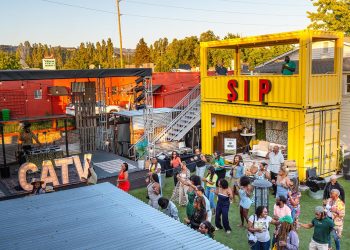
This is not your average wine event; participants come away from our events with conversation notes about alternative economics and the connection between land prices and what’s grown vs. what naturally grows here and doesn’t have to be tended to. These are newer conversations that catch people by surprise.
As you develop the mission and vision for Anything But Vinifera (ABV), what do you want consumers to understand about the education platform you are creating?
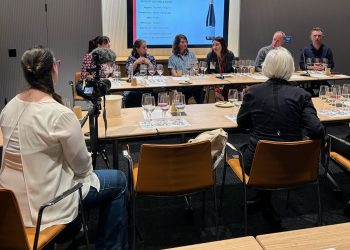
We have taken a dual-pronged approach, where we’re fine-tuning what we need in the moment. Our first event in Brooklyn was to lay the foundation. We had a focus on buyers and consumers. In our panels, we spoke about the intersection of environmental and social sustainability. This led to an expanded conversation acknowledging that by increasing the diversity in the base product of our ferments, we can be kinder to our land.
This is not only a response to climate change; when we have land and material at a lower cost, you can exchange ideas openly. This starts to attract folks who may want to avoid navigating the mainstream or are barred from navigating the mainstream. That was volume 1; in volume 2, we went to a completely different market which was Florida. We wanted this to be more of a community offering, so our seminars and workshops were the day’s main focus, and the tasting played a supporting role. We had six different workshops aimed at land access and politics.
How has the local community responded to the work you are doing? What were some of the most impactful insights participants shared during or after your events?
One of my favorite experiences was in Miami during our last panel. My favorite experience in Miami was during our last panel. I was moderating it. I had Chris Renfro from the 280 projects, Ashton Lewis from Ashanta, and Justine Belle Lambright from the Kalche wine cooperative. We were discussing co-ops, mutual aid, and community-centered care. During the whole panel, there was this woman in the back who just kept saluting us. She wasn’t the tallest in the room, but she was standing in the back, so she would jump in order for us to see her saluting us. She was full-on body jumping. Seeing that energy, knowing that we were feeding her and she was feeding us back like that. It was everything, truly.
Additionally, something special that we do is use fermenting and wine as a lens, but we touch on so many different things. So wine folks, when they come to these vents, they leave with a renewed sense of how much they can affect and influence their space. We had a guy approach us after the event to discuss land he owns and doesn’t know what to do with it. This evolved into a conversation about black and indigenous land stewardship. Sometimes, due to social conditioning and financial reasons, it’s challenging to get back to the land that calls to us. We must remember that if the system was designed this way, we must counter it.
How has education on land stewardship improved the unification of diverse communities?
I think that sometimes we think in a vacuum. Divorcing the exclusivity of grapes within the conversation really helps, and if you do that, then it’s just farming. Fermentation is way down the line, which is a big reason we did our gardening workshop. The goal was to encourage people not necessarily to think on such a grand scale all the time. You can grow things on your windowsill. If you can grow your own food that’s really powerful, that’s a step towards sovereignty. Then fermenting becomes kind of like a second fall.
I have all this bounty; what can I do to preserve it? This is another part of the conversation that we were having. Food should not be for just fermenting. If we’re talking about sustainable farming, what’s good for the earth, and what’s good for humanity. The first thing you want to do with your land is make sure people are fed; if there is excess, you ferment that. Deprogramming this very colonial and exclusive idea of what wine is and can be is at the center of what we do.
What events are you looking forward to curating next for your community?
We completely bootstrap for the events we host, meaning we do peer-to-peer fundraising. All of our money comes in really small increments. As we lead up to our next event, we will have surrounding events that will double as fundraisers. This will happen in multiple states from now until July. Continue to plug into our Instagram to find out what we are developing. Additionally, you can support our events by purchasing an Anything But Vinifera tote bag.

Related Posts