Can Abstinence Make The Heart Grow Fonder
Abe Zarate’s Masterclass On Building a Wine Community Through Sobriety

It’s been almost five years since “Sober Somm” Abe Zarate quit drinking alcohol, in August of 2020. Sobriety is an unconventional choice. The central focus of the job of sommelier is to specialize in all aspects of wine service, pairing, and education. Yet, Abe Zarate continues to educate, connect the community, and deliver fresh nuance and inspiration about the very beverage from which he abstains.
A Sobriety Journey Rooted in Self-Preservation
Abe’s sobriety journey came from a desire to embrace life, his relationships, and to save his wine career. His co-dependent relationship with alcohol was impacting his relationship with his sisters, his finances, and his career. To preserve all three, he quit drinking. “I hit a fork in the road where I knew where one of those paths would lead me, and that would have an end, and the other was just a Hail Mary,” he said.
He tried to approach his journey as a sober sommelier the same way he approached coming out as gay, “which was just looking at other people’s accounts, speeches, and resources, and I was doing the same for anyone that might be sober in the beverage industry. So I was frantically looking for sober sommelier hashtags.”
Championing Connection Through Sobriety
It’s easy to see how being one of the first people to come out as sober in the wine community could be scary and uncertain. It’s inviting criticism by distinguishing yourself as different from the larger group. But unlike coming out as a gay man, there weren’t many role models for Abe Zarate to confide in or emulate as a sober sommelier. Most sommeliers don’t advocate for sobriety-focused events like Dry January, which can notably impact sales. There’s a growing sentiment in the wine world to encourage “drinking less, but better.” This approach aims to reexamine the role of wine in people’s lives and promote quality over quantity.
Inspiration and Guidance on the Sobriety Path
He found some inspiration for his endeavor when he came across an interview with comedian Nikki Glaser, citing the one book she read to quit drinking, “The Easy Way to Stop Drinking” by Allen Carr. He used the book to begin his inner journey of “debunking the myths that we all tell ourselves about alcohol,” he said. “Something trivial is, ‘I won’t be fun anymore,’ which is important, because from that point, you start feeling like you’re missing out on things, and remove yourself from experiences just because you’re scared of a substance. Which I didn’t want to be. Plus, it’s an industry that I love very much, so I wanted to remain in it.
Not only has he remained in the industry four years after quitting drinking, he has become a much needed community leader. He currently sits on the board of Corporate Pero Latinos, a non-profit organization dedicated to empowering Latinx professionals in the corporate world while making a positive impact in their communities. He volunteers to teach English classes to hospitality workers in the Latinx community and co-leads CPL’s English as a Second Language Program, which aims to eliminate language barriers for members of the Latinx community in the hospitality industry.
Creating a Space for the Sober-Curious Community
He’s also paving the way for a community that’s usually overlooked in the wine industry: the sober-curious. In January, he created a 31-day Instagram series detailing a nugget of wisdom per day of what he’s learned through his sobriety journey and serving as a beacon of hope and guidance for people who might be on a similar journey: loving the experiences, community, and purpose that wine, and the wine industry brings them while understanding that they may need to abstain from it themselves.
Passion for Wine Beyond the Glass
He doesn’t see his sobriety and his passion for wine as a sommelier as mutually exclusive. “Everything is more connected than we like to think. I’m not championing sobriety, nor am I championing alcohol. I’m championing just connecting with what’s good for you and allowing yourself to explore what you want to explore by reframing everything around alcohol.”
An artist at heart, this music industry graduate sees wine as a work of art and a profound experience. “I fell in love with the idea of two ounces of wine being able to retain qualities of where it came from, how it was treated, where it grew up, and the fact that it continued changing within the glass, and just even within that class, connecting with people over it.”
Abe Zarate Connecting Wine with Memories and Emotions
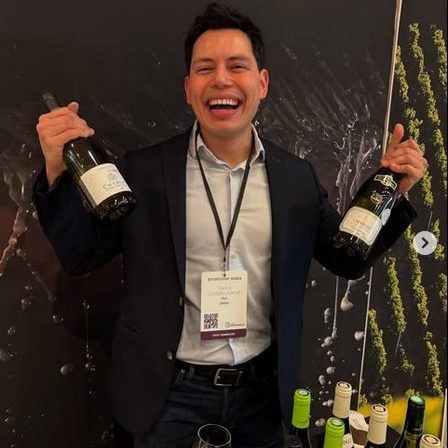
Abe sees wine as a connection to our memories, our stories, and our emotions. “It’s a total emotional experience. Even if you hate wine, that’s an emotion that it’s sparking. Really it’s pulling from memories,” he said. “That’s why I love when people give me descriptors of ‘oh, this, you know, reminds me of my grandma’s closet,’ and that means something different for everyone, but there is also a universal feeling attached to it.”
A Final Toast to Sobriety and Connection
Abe’s sobriety journey is a reminder that the experience that you have with the glass is a reflection of what you have in your heart and soul. His passion for wine shows us that whether you drink or not, wine is what you make it, and it’s a gift to all of us. In discussing that connection, he notes “A big part of wine culture is, what allows for connection with another human person, which again, is what we’re all looking for. We all just want to connect. And yes, a glass of wines can be a great means to an end. But it’s not because of the wine itself. It’s because of the experience around it.”

Related Posts